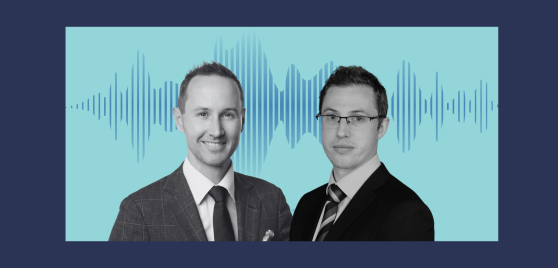
Featuring Michael O'Neill
LISTEN
READ
The Australian share market had another good year in 2025, the third year in a row of greater than 10% returns. But what were the standout stocks and sectors, and where do the opportunities lie in 2026?
In this podcast IML Portfolio Manager Michael O’Neill discusses the main drivers of returns last year, as well as giving an update on the performance of IML’s large cap funds and his thoughts on what 2026 might bring.
Follow our podcast, ‘Navigating the Noise’ on Spotify, Apple or Amazon to be notified of new episodes.
 |
 |
 |
Lightly edited transcript – Recorded on 8 January 2026
Carl: Hello and welcome to Navigating the Noise, a podcast by Natixis Investment Managers, where we bring you insights from our global collective of experts to help you make better investment decisions. I’m Carl McMinn, and today I’m joined by Michael O’Neill from IML.
Mike is a long-standing portfolio manager in IML’s large-cap team, and he also co-manages the IML Equity Income Fund and associated ETF EQIN.
Mike, Happy New Year. Welcome to the podcast.
Michael: Happy New Year, Carl.
Carl: So, Mike, another good year for Aussie equities. Healthy dose of volatility this year. The ASX 300 accumulation index is up just over 10% for the year, the third year in a row it has been more than 10%. What are your takeaways for investors maybe over the last quarter and then expand that into the last year, 2025.
Michael: Yeah, Carl, it has been a hat trick of double-digit returns. Quite strong markets, not just in Australia but overseas. I think the S&P 500 was up 11% in the second half of the year. We <the ASX 300> were up 4% over that same period, totaling 10.7% for the overall year.
The key takeaway is we’ve had a very extended bull market since the GFC, and it’s not just equity markets that have been buoyant; it’s also other classes like real estate, crypto, and precious metals.
So what’s been driving it? Not so much economic growth; that’s been quite tepid. The weight of money through money printing that we’ve seen has been a real fuel behind asset prices. It’s only recently that we’ve started to see consumer price inflation post-COVID. In Australia, we’ve been a bit slow to the party. The RBA was slow to tighten rates, calling the inflation transitory. Now we’re seeing signs of it accelerating, and we face hikes.
Usually, what happens is that equity markets do follow bond markets and bond yields have been rising too, so higher yields usually cap our valuations. We’ve just recently seen some weakness in some of the higher PE stocks.
Overall, another good year on markets, but facing into some rising risks around persistent inflation, concerns around debt levels globally, and concerns around valuations and expectations for some of the higher PE names and the AI-themed parts of the market, which are starting to look a bit shaky.
Carl: OK. Turning to IML’s large-cap portfolios, you had a strong start to the year, a bit mixed for the rest of the year. Can you walk us through some of the main reasons driving that performance, as well as maybe touch on some key sectors and names that contributed to those results?
Michael: Sure. The large-cap funds across the board did deliver positive returns, but most did underperform their benchmarks. The only exception was the All Industrial Share Fund, which did outperform the ASX 300 industrials index. Quite pleasingly, our Equity Income Fund and our EQIN ETF met their objectives. The Equity Income Fund achieved a yield of 6.3% net of fees before franking, much higher than the market at 3.5%. With much lower volatility, I think, in fact, if you grossed up that income yield, it was 7.4% for the year.
Across all our funds the performance was certainly supported by some of our defensive industrial holdings, but there are still a lot of great companies that are lagging the index despite delivering strong results. I think relative to the benchmark, the performance was negatively impacted by strength in resources stocks and the disappointing performance of some of our key holdings, including CSL and Steadfast.
Carl: Individual stocks, which ones contributed the most over the last year and which ones held you back?
Michael: I think across large-cap funds, we benefited from strong returns in stocks like Orica, Telstra, Brambles, Medibank Private, Charter Hall Retail REIT, and Dalrymple Bay Infrastructure. You can see the diversity of portfolio holdings and individual stocks driving the performance.
But some of our core holdings like CSL, Steadfast, Suncorp, and Amcor did drag on our performance. We see their valuations as particularly attractive relative to the market now, especially if volatility does return.
I think the most disappointing performer – CSL, was particularly disappointing. We’ve discussed it in previous podcasts, and when we have holdings that have a significant fall in share price, it triggers us to dive into a rigorous peer review of the investment thesis – think about whether it’s changed. Following that disappointing second-half result, we downgraded our earnings forecast somewhat, but we did conclude that the quality of the business was intact.
They’re the number one player in the plasma industry, which has mid to high single-digit structural revenue growth and should help them deliver high single-digit to low double-digit EPS growth. If you include plasma initiatives into the mix, this should also underpin lower capital needs and increase cash returns over time. The stock is now trading on 16 times PE (price to earnings) a significant discount to many other companies which we see as higher risk and lower growth, such as the major banks. It looks particularly appealing now.
Carl: Nice. Um, maybe if we wind it back to the last quarter, it’s always great to talk and share with investors the changes we’ve made recently. What have you done over the last quarter or so?
Michael: Well, more recent portfolio changes included buying Cleanaway and BlueScope Steel. Cleanaway is Australia’s leading waste management and resource recovery company. It has great relationships with councils and controls scarce landfill assets in metro markets. As you can imagine, new landfills aren’t readily being built, and this creates a very strong moat for the business.
In the case of BlueScope, it’s one of the few cyclical companies we own. We bought it at what we saw as cyclically depressed steel spreads, with growth opportunities in its North Star business and cash flow set to improve following what was a period of very heavy investment. This should mean more buybacks and dividend growth. Interestingly, this week, BlueScope received a $13.2 billion all-cash takeover offer from Steel Dynamics, a company listed on the NASDAQ, and SGH, the conglomerate owned by the Stokes family.
Other things we did included topping up positions in Dalrymple Bay Infrastructure and Macquarie Bank at attractive prices. On the other side of the coin, we reduced our holding in Orica. We generated a total return of over 50% for the calendar year during that stock, so it was warranted, and we also further reduced our exposure to the major banks, particularly CBA earlier in the quarter, which proved to be a sensible move.
Carl: Alright, Mike, crystal ball time. How do you see things playing out in 2026? What are the main things you’ll be watching closely, and what do you recommend investors keep an eye on?
Michael: Well, I’m no better than anyone else at predicting the direction of markets, Carl. But I do know one thing: after three years of double-digit returns on the ASX, valuations are looking stretched.
So what I’m asking myself and what investors should be considering is: when markets are near all-time highs, what could go wrong?
Inflation’s persistent, economic growth has not been strong enough to support the valuations we’re seeing, and momentum in share prices can’t last forever. We expect volatility to return, which favours defensive value investing, and it also presents new opportunities to investors like IML when high P/E stocks fall out of favour.
Coming into reporting season, we’re cautiously looking at momentum and cyclical companies, this is where we see more risk, particularly IT, consumer discretionary, materials, and financials. Companies with high valuations are also looking a little bit more exposed because high bond yields normally cap equity valuations. We’ve already seen some higher PE stocks under pressure and some artificial intelligence-themed companies called into question, so our positioning is defensive.
I suggest putting your attention into stocks in sectors like healthcare, telcos, and select industrials will result in more reliable cash flows, with valuations less sensitive to rates. So you’ve got to be selective.
I think also, importantly, for income investors, the market yield isn’t what it once was. The long-term average yield of 4.5% is no longer available if you invest in the ASX 300. The outlook is for a yield closer to 3.3% mainly because of the valuations on the major banks, tech, gold miners, data centres, as well as some lower dividend payouts for resources. But I do know one thing, Carl, there’s a listed stock providing 2% higher income after fees with lower volatility: that’s EQIN.
Carl: Perfect. Well, on that note, we’ll wrap it there. Thanks, Mike. It’s always a pleasure to talk to you and thanks for providing all those insights today. And thank you to our listeners for doing the same. If you enjoyed the episode, please click follow on your favourite podcast platform and tune in again to hear more from our global collective of experts.
This podcast has been prepared and distributed by Natixis Investment Managers Australia Proprietary Limited, ABN 60 088 786 289, AFSL 246830 and includes information provided by third parties, including Investors Mutual Limited (“IML”) AFSL 229988, the responsible entity and investment manager for the IML Funds.
Although Natixis Investment Managers Australia believes that the material in this podcast is correct, no warranty of accuracy, reliability, or completeness is given, including for information provided by third parties except for liability under statute which cannot be excluded. This material is not personal advice. The material is for general information only and does not take into account your personal objectives, financial situation or needs. You should consider and consult with your professional advisor whether the information is suitable for your circumstances. The opinions expressed in the materials are those are the speakers and may not necessarily be those of Natixis Investment Managers Australia or its affiliate investment managers. Before deciding to acquire or continue to hold an investment in a fund, you should consider the information contained in the product disclosure statement in conjunction with the target market determination, TMD, available at www.iml.com.au.
Past investment performance is not a reliable indicator of future investment performance and no guarantee of performance, return of capital, or a particular rate of return is provided. Any mention of specific company names, securities or asset classes is strictly for informational purposes only and should not be taken as a recommendation to buy, hold, or sell. Any commentary about specific securities is within the context of the investment strategy for the given portfolio. The material may not be reproduced, distributed, or published in whole or in part without the prior written consent of Natixis Investment Managers Australia.
Copyright 2026 Natixis investment Managers Australia. All rights reserved.



INVESTMENT INSIGHTS & PERFORMANCE UPDATES
Subscribe to receive IML’s regular performance updates, invitations to webinars as well as regular insights from IML’s investment team, featured in the Natixis Investment Managers Expert Collective newsletter.
IML marketing in Australia is distributed by Natixis Investment Managers, a related entity. Your subscriber details are being collected by Natixis Investment Managers Australia, on behalf of IML. Please refer to our Privacy Policy. Natixis Investment Managers Australia Pty Limited (ABN 60 088 786 289) (AFSL No. 246830) is authorised to provide financial services to wholesale clients and to provide only general financial product advice to retail clients.