By Michael O'Neill
READ
For the better part of a decade, global equity markets have been myopically focused on capital growth. Propelled by an era of ultra-low interest rates and cash-saturated economies, and lately supercharged by AI optimism, growth stocks (primarily US megacap tech) have driven indices to dizzying heights. For many investors, steady, cash-generative income strategies began to look like relics of a bygone era.
Yet, tides inevitably turn. As the global economic landscape shifts, the structural proposition supporting pure growth investing is beginning to wobble. Today, facing stretched valuations, heightened geopolitical tensions, and a looming overhaul of the Australian tax system, the risk-reward trade-off for Australian investors has fundamentally changed. Now the source and reliability of returns matters even more, and equity income is fast becoming the prudent investor’s primary engine of return.
We are entering an era where income will need to do more of the heavy lifting of wealth creation in Australia.
In a fragmented, highly concentrated share market, dividends can be an important anchor
The global environment has become more uncertain. Persistent geopolitical instability, trade protectionism, and structurally higher inflation present ongoing headwinds to global growth. Simultaneously, equity benchmarks have reached levels of concentration that should give any disciplined investor pause.
The spectacular rise of a handful of US megacap technology firms, and more recently unprofitable moonshots, has been fuelled by an AI narrative that leaves little room for disappointment. History suggests that when markets become so narrowly focused, even minor disappointments can trigger swift and punishing corrections.
When capital appreciation becomes volatile and unpredictable, dividends provide a useful cushion, particularly for retirees who are reliant on income to fund their lifestyles and could suffer real setbacks from selling down assets in volatile markets. Dividend income is historically far more resilient than capital growth. While share prices can swing wildly on shifting sentiment, distributions which are anchored to consistent cash flows can be very stable. Over the last 30 years, dividends have returned 47% of overall returns, and done so with much lower volatility. Take a look at this chart of ASX 300 returns over the last 30 years with the light blue bars showing dividends and the dark blue bars showing capital growth.
ASX 300 capital and income returns over 30 years
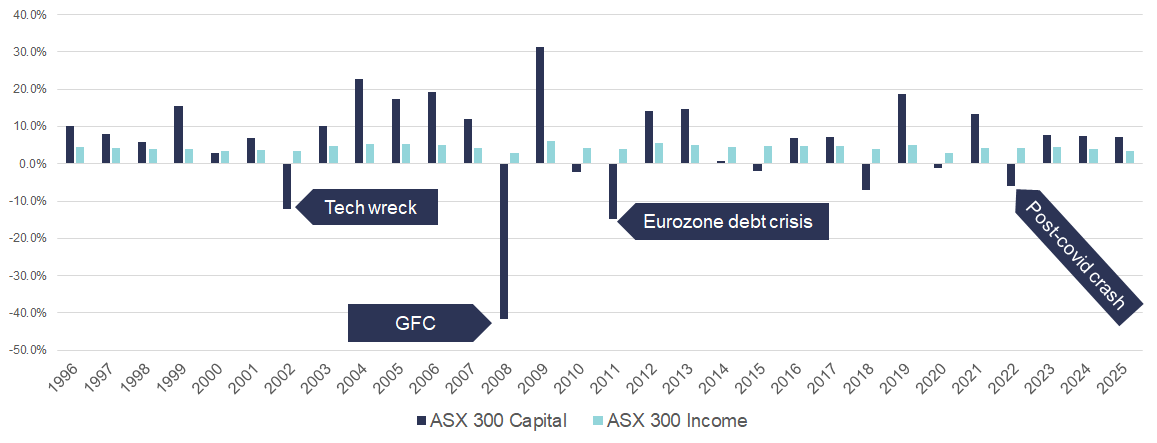
Source: IML, Factset, as of December 31, 2025
When you invest for income, you are effectively paid to wait. In sideways or falling markets, this steady cash yield is a critical defensive buffer, offering a layer of comfort that speculative growth simply cannot match.
A structural shift in tax policy makes franked dividends an even more valuable prize
For Australian investors, the most urgent catalyst for a strategy rethink comes from Canberra. The Federal Government’s recently legislated tax overhaul is set to structurally alter the economics of investing.
From 1 July 2027, the tax consequences of selling shares at a profit will become significantly more onerous for individual investors, trusts, and partnerships. The abolition of the long-standing 50% Capital Gains Tax (CGT) discount for assets held over 12 months is a watershed momenti.
In its place, the reintroduction of the indexation system—which adjusts the cost base for inflation—will offer a vastly inferior tax shield in all but the highest-inflation environments. Combined with a new 30% minimum tax rate on net capital gains, the profitability of growth-focused investing will be adversely affected. Companies that retain capital to fuel growth rather than returning it to shareholders will face a tougher sell, as investors must contemplate a far heavier tax burden upon exit.
Crucially, ordinary equity income remains insulated from these changes. Dividends and option premium will continue to be treated as ordinary assessable income, subject to marginal tax rates. This preserves the advantages of Australia’s unique imputation system. Because the franking credit system remains fully intact, income from quality shares will receive no such tax penalties.
While the statutory rules governing franking credits are unchanged, their relative value is set to rise. As the tax burden on long-term capital gains increases, fully-franked dividends will stand out as the one of the country’s most tax-efficient vehicles for wealth accumulation outside superannuation. Because ordinary income and franking are untouched, an income-focused strategy with a higher-than-average franked yield is among the parts of the market least exposed to these changes. As a result, we would expect demand for income strategies to strengthen.
Volatility is here to stay, but it can be harvested to your advantage
The third pillar of the income argument lies in volatility. The modern trading environment is noisy and driven by momentum as algorithmic, quantitative, and passive trading strategies gain greater sway. While this elevated intraday volatility can be unsettling for traditional buy-and-hold capital investors, it represents a distinct opportunity for those focused on income.
In option markets, heightened volatility translates directly into higher premiums. This means that when markets are choppy, the opportunity to generate additional income through the disciplined writing of options increases.
Many income-focused funds adopt an aggressive posture, writing covered calls indiscriminately to manufacture increased yield. The danger of this approach is capital erosion: when the underlying shares rally strongly, the fund is forced to sell its winners, regardless of whether or not they think it’s too early to sell.
At IML, our approach is deliberately conservative. We treat options not as a mechanical income-stripping exercise, but as an extension of our fundamental investment process. We write options to complement our fundamental buying and selling decisions, rather than chasing premium for its own sake. Where possible we look to preserve some capital upside in the portfolio.
In managing the IML Equity Income Fund and ETF (ASX:EQIN), our objective is to deliver a net income of 2% above the ASX 300 — consistently and reliably, with lower volatility than the ASX 300. Through the cycle the fund tends to generate roughly 4% from dividends plus around 2% from option premium, and 1% through net realised capital gains after fees, plus with franking on top. The composition can change and diversification of sources is key.
Remember the true engine room of total returns
In an era of relentless market noise, it is easy to lose sight of the fundamentals. A look at the data yields a sober reminder: over the past three decades, around half of the total returns from the Australian equity market have been generated by income. Historically, more of the returns from capital gains ended up in your pocket, due to their favourable taxation, however now the equation has changed. Income is more valuable than it was, and franked dividends are even more valuable.
As we confront an era defined by geopolitical friction, stretched growth valuations, and a new taxation regime that treats capital gains more harshly, the importance of equity income has never been clearer.
Find out more about IML’s Equity Income Fund and associated ETF (ASX:EQIN).
i These measures were legislated in the Treasury Laws Amendment (Tax Reform No. 1) Act 2026 (and the Income Tax Rates Amendment (Tax Reform No. 1) Act 2026), which received Royal Assent on 26 June 2026, following the 2026–27 Federal Budget handed down on 12 May 2026.
This publication (the material) has been prepared and distributed by Natixis Investment Managers Australia Pty Limited ABN 60 088 786 289 AFSL 246830 and includes information provided by third parties, including Investors Mutual Limited (“IML”) AFSL 229988. Although Natixis Investment Managers Australia Pty Limited believe that the material is correct, no warranty of accuracy, reliability or completeness is given, including for information provided by third party, except for liability under statute which cannot be excluded. The material is for general information only and does not take into account your personal objectives, financial situation or needs. You should consider, and consult with your professional adviser, whether the information is suitable for your circumstances. Past investment performance is not a reliable indicator of future investment performance and that no guarantee of performance, the return of capital or a particular rate of return is provided. You should consider the information contained in the Product Disclosure Statement in conjunction with the Target Market Determination, available at wwwiml.com.au. It may not be reproduced, distributed or published, in whole or in part, without the prior written consent of Natixis Investment Managers Australia Pty Limited and IML. Statements of opinion are those of IML unless otherwise attributed. Except where specifically attributed to another source, all figures are based on IML research and analysis. Any investment metrics such as prospective P/E ratios and earnings forecasts referred to in this presentation constitute estimates which have been calculated by IML’s investment team based on IML’s investment processes and research. The fact that shares in a particular company may have been mentioned should not be interpreted as a recommendation to either buy, sell or hold that stock. Any commentary about specific securities is within the context of the investment strategy for the given portfolio. Any reference to a ranking, a rating or an award provides no guarantee for future performance results and is not constant over time.









INVESTMENT INSIGHTS & PERFORMANCE UPDATES
Subscribe to receive IML’s regular performance updates, invitations to webinars as well as regular insights from IML’s investment team, featured in the Natixis Investment Managers Expert Collective newsletter.
IML marketing in Australia is distributed by Natixis Investment Managers, a related entity. Your subscriber details are being collected by Natixis Investment Managers Australia, on behalf of IML. Please refer to our Privacy Policy. Natixis Investment Managers Australia Pty Limited (ABN 60 088 786 289) (AFSL No. 246830) is authorised to provide financial services to wholesale clients and to provide only general financial product advice to retail clients.