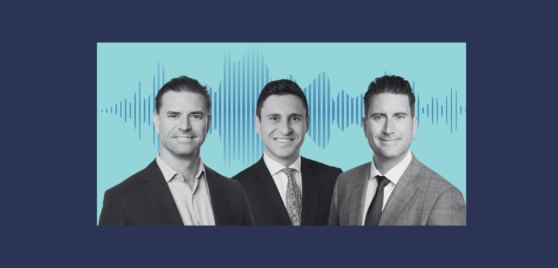
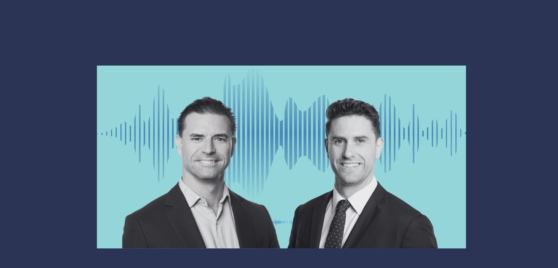
Featuring Marc Whittaker and Lucas Goode
LISTEN
READ
IML portfolio managers Marc Whittaker and Lucas Goode discuss the AI selloff during reporting season and how the immediate risk to many smaller companies might be overblown. They take a detailed look at Hansen Technologies (ASX: HSN), a software stock which managed to avoid the worst of the selloff, partly through a strong result and also through its CEO effectively communicating how Hansen is, in fact, benefitting from AI disruption. Finally, Marc and Lucas take a look at the incredible ~60% outperformance of small cap resources companies over industrial companies over the last six months and discuss whether this is likely to continue.
Follow our podcast, ‘Navigating the Noise’ on Spotify, Apple or Amazon to be notified of new episodes.
 |
 |
 |
Lightly edited transcript – Recorded on 4 March 2026
Jason: Hello, and welcome to Navigating the Noise, a podcast by Natixis Investment Managers, where we bring you insights from our global collective of experts to help you make better investment decisions. I’m Jason Guthrie, your host, and today I’m joined by Marc Whittaker and Lucas Goode, both leading PMs for IML small and mid-cap strategies. It’s great timing to have them back on the podcast as we move to the end of reporting season here in Australia. We’re going to cover some of the highlights from reporting season, but we’ll also go into some detail around a stock that really caught their eye, Hansen Technologies (ASX:HSN). Marc and Lucas, welcome back to the pod. Great to see you both, and looking forward to diving into things today.
Marc: Thank you, Jason, for having us. Great for Lucas and I to be back on the podcast.
Jason: So reporting season is about to wrap, and as always, we see increased volatility. We did see an extra dimension with the big selloff in some software companies, mostly due to concerns around AI. We’ve covered some of this last week with Dan Moore and the large cap names, but how much of this do you see as really impacting that small and mid-cap space, and what are your overall thoughts on reporting season thus far?
Marc: Thank you, Jason. I think you mentioned the word volatility, so I think that’s a very apt term to describe what we just saw across reporting season. Certainly the AI contagion, I guess you would argue, or the fear around disruption of AI to incumbent business models was front and foremost in investors’ minds, and certainly played a role in the volatility we saw in February.
I think the fact the RBA was putting up rates at the beginning of the month was a bit of a headwind for stocks, particularly in that small cap industrial space where domestic-focused companies are probably going to feel the teeth of a rate rise more readily than perhaps some of the offshore exposed companies on the ASX.
And then again, just generally it was reporting season, right? So you’ve always got some good results, you’ve always got some soft results and those results tend to be magnified depending on the mood of the day and how markets are operating. But I think generally we saw some pretty decent results. We met a lot of management teams, we had a lot of good discussions with CEOs and CFOs. And I think generally the mood that we took away from those meetings, Lucas, was generally pretty good.
Lucas: Yeah, I’d completely second that, Marc, the feedback we had was broadly positive. I mean, interestingly, even some of the feedback on the Australian economy itself was better than what you might have thought from reading newspaper headlines. I guess there’s a lot of focus on the consumer in the media, it makes sense, we’re all consumers – clearly the rate hike not positive there. Also probably not positive for small caps overall, given the way smalls tend to trade in relation to the large caps, they usually suffer from higher rates. But some of the feedback, I mean, it was interesting, you know, we met with Judo Bank – I thought a really good result that didn’t get rewarded. But they were just highlighting that credit growth is significantly above long-term averages at the moment – that’s business credit growth – and that actually investment in Australia’s really strong at the SME end.
Marc: Yeah. And of course, as you do appreciate, Lucas, our portfolio does tend to be a little bit more defensive orientated. So a lot of the names that we own, the likes of Ridley and Bega, companies that we met through reporting season, they all reported pretty good results. And you could argue those sorts of companies are more resilient in the face of either volatile economic conditions or just generally investor nervousness.
Lucas: Yeah, of course we had some positive announcements as well, ClearView getting a takeover offer from Zurich, Kelsian got a really good price for the sale of its tourism assets – it’s something we’ve been pushing the board to dispose off for quite a while, so we’re really happy with that and the share price rallied in response. But as I’ve said, it’s just a really tricky reporting season and any misses, particularly in anything that had been identified as AI exposed, just absolutely pummeled.
Jason: We’re certainly seeing some incredible moves across the market. I would love to dive a little bit deeper into the tech sector and maybe we can use Hansen Technologies as a bit of an example, I believe Hansen’s had quite a long journey since listing in Australia initially as a startup, really gradually becoming a global software provider over the years, and it plays a pivotal role in the operation of many essential services that we all use day to day. We’ve obviously seen a lot of downside in many software companies in Australia and globally, and Hansen has been caught up certainly in that selloff from its highs the last year, but it looks like it’s actually bounced substantially over the last couple of weeks post reporting. So Lucas, maybe could you run us through what exactly is going on with the company?
Lucas: Yeah, sure. Thanks, Jace. I mean, with Hansen, it had a very strong result. But you zoom out a little bit further, it did get caught up in the SaaS apocalypse, as I’ve heard it called, but that general software route. It fell 16% between the start of the year and the day before results. So it definitely got caught up in that rout, even though the company was trading at a significant discount to the market. So it’s not like it was relying on long-term growth expectations in the same way as some of those more glamorous, larger stocks like Xero, ProMedicus. Now the stock has rallied about 20% since the result, and I’d highlight two key reasons. I mean, first was the result itself was fantastic. It really was. 16% recurring revenue growth, 69% cash EBITDA growth.
But secondly as well, we’ve been talking about those AI concerns. I think Andrew Hansen, the founder and CEO, did as good a job as any ASX CEO explaining exactly why Hansen is not at risk from AI substitution and in fact has already proven to be a winner from implementing AI in its own business.
lf we look at exactly what Hansen is, this is a company that provides billing solutions to utilities and telcos. It’s deeply integrated into those customers’ tech stacks. You know, a lot of software gets called mission critical, usually by the companies themselves to explain why the customers can’t possibly replace them. But in Hansen’s case, customers quite literally cannot collect revenue without their software.
These are also highly regulated and complex industries, particularly something like an energy utility. There’s just no desire or ability for those customers to rip and replace a system like this with something that a company’s internal IT team has vibe-coded on Claude or whatever over the weekend. We think Hansen really has a strong moat within its existing customer base and a really relevant and modern tech stack.
But I think what’s great to see from Hansen is how they’re benefiting already today and the proof’s in the pudding. I mentioned the 16% recurring revenue growth delivered in a half, but they delivered that increase in revenue with a materially lower employee cost base, and that’s as a direct result of the increased productivity of its engineers, due in large part to the adoption of AI tools.
And it’s also worth highlighting that the company is already deriving revenue from its own AI tools. So they’ve got eight AI solutions that are already being sold in market today. And I think that’s something really worth bearing in mind for investors looking at enterprise software in general, because not every legacy company is going to make it to the next stage. We saw this in the on-prem to cloud transition, but there’s real benefits to incumbency. Customers absolutely want to experiment with and benefit from AI, just like we do at Investors Mutual. But where are they likely to turn to for that, especially within critical business functions? Well, I think in many cases, they’ll actually look to use tools that are developed and provided by trusted vendors like Hansen.
Marc: That’s right. And I think what I was particularly impressed with with their result was their presentation where they really made a very emphatic case about why AI is actually a benefit, a friend, not a foe in terms of their business model, their relationships they can build with their customers and how AI can actually help them penetrate deeper into that customer base. I thought that was quite a good approach to the issue.
Lucas: Yeah, it was really apparent when we spoke to them, wasn’t it? Where they said: “The market might have only been obsessing over AI for three months, but we’ve been developing AI products for three years.”
Marc: We’ve been thinking about it a lot longer than the new Johnny-come-latelies.
Lucas: This isn’t new to us.
Marc: That’s right. So I thought they addressed that issue actually quite well.
Jason: You spoke about the regulated nature of the services. What kind of customers are they actually looking after? What are their largest accounts today? Can you give some examples?
Lucas: Yeah, sure. So their largest customers are actually on the telecommunication side. So Telefonica Deutschland and Virgin Mobile O2 in the UK. Those tend to be bigger ticket accounts just because of the size of those customers. They’re obviously major telcos with tens of millions of customers.
On the utility side, I mean, there’s numerous utilities all across Europe that they deliver products into. They also acquired a business called Power Cloud in Germany last year, which we think has been an absolute masterstroke. They bought it for a song because it was losing money at the time. They’ve already removed half the cost base and returned it to profitability. Germany is quite a long way behind other markets in terms of deregulating and moving to the likes of smart meters that we take for granted in Australia, that’s going to lead to more complex billing solutions: therefore, as those companies refresh their tech stacks, they need a provider like Hansen to support them.
So it’s quite a diverse customer base, but as I say, generally in heavily regulated and complex industries on the utility side. And then on the telco side, the communications cloud suite that Hansen provides, it is an industry-leading solution. They’ve got great reference customers, and these are major IT refreshes that these major telcos go through maybe once every decade, and Hansen will be part of that refresh alongside other software vendors.
Jason: Okay. So for good reason, Hansen’s obviously up strongly over the past few weeks post-reporting. With that rerating that you’ve seen in the portfolio, how’s the team thinking about current valuation, its future growth prospects from this point?
Marc: You know, we, we certainly still like it a lot, Jason. I think in the past, sometimes we’re accused of not owning the right technology stocks, that we’ve missed some of those really highly valued, or overvalued we would argue, high-growth tech stocks.
But Hansen’s been one that’s been right in our sweet spot. We like it. It’s got good growth in front of it with a high degree of recurring earnings as Lucas has pointed out, high return on capital. So capital-light business, a long runway of growth in front of it. And it’s always been very reasonably priced, which is why we’ve liked it as well. So I think Lucas, correct me if I’m wrong, but about 13 times free cash flow.
Lucas: That’s right, Marc.
Marc: Very hard to find a tech stock that’s been trading around those multiples in recent times, and that’s well before the selloff. So again, a very reasonably priced business and what we think is a really high-quality business at the same time. As we said, I think AI is actually an opportunity for the likes of our Hansen to build deeper relationships with their customers, not the other way around.
Jason: And more broadly, I guess, we’ve obviously seen some pretty stark figures printed showing that while the ASX small resources is up around 50% over the past six months alone, small industrials, it’s, I think you mentioned at the start has been a bit tougher there and they’re actually down around 10% over that same period. So that’s a very large dispersion in performance. So what are the main drivers of this do you think, and do you think this performance gap will close in the future?
Marc: I think clearly, as we often see in small caps, you often get a, a divergence in markets, a sector or two will garner some momentum or investor enthusiasm and the rest of the market will sort of suffer as a consequence.
There’s probably a couple of reasons why, but if we look at that divergence between resources and industrials in particular, I think you’ve got to go back 25 years before you find a similar sort of level of divergence. So this is really a once in a investor generation event that we’re seeing.
But when you think about the reasons why resources and materials have probably been so strong, I think a lot of it’s obviously been a flight to safety, so gold’s been a big driver of that.
So as we’ve talked about, you’ve had that geopolitical uncertainty, AI as a threat to virtual businesses. So people are looking for hard assets, whether it’s commodities in the ground, hard infrastructure businesses, those sorts of companies which are really immune to AI, they’ve all sort of benefited from that flight to safety, that flight from geopolitical volatility. But I think more recently what we’re seeing, is quite interesting, obviously we’ve had weakness in the US dollar as well, and that’s been a driver of commodity prices as well. You know, the lower the US dollar is, the more commodity prices tend to increase because they’re often priced in US dollars. So as the US dollar falls, commodity prices tend to move a little bit higher. We’re seeing that start to reverse just a little bit now.
Obviously what we’re seeing in Iran and the Middle East means that there’s now a real flight to safety and that’s the US dollar. And we are seeing quite extreme volatility in the likes of gold and other commodities. And we would argue quite strongly that gold’s actually not really a defensive asset anymore. It’s become more of a speculative asset. And there’s a lot of momentum money in that particular asset class and that money can quickly flow out of that asset class as well if things continue to be volatile.
So it wouldn’t surprise me to see commodities remain volatile and actually start to give back some of those gains. And where I think the real opportunities are and where we see the portfolio setting itself up for over the next two to three years is these, what we think are high quality, really reasonably priced industrials which have been left behind and we think will deliver over the next two to three years, despite the macro environment that we’re seeing offshore, despite the gyrations we might see in the local market. The earnings are solid, the franchises are long duration, we think they’re good quality businesses, and they’ll continue to deliver. And if you hold them with sufficient dividend yields at the same time, we think you’ll be rewarded over the longer term.
Jason: We might wrap it up there. So thank you Marc. Thank you Lucas. Appreciate your time. It’s great to get your views through reporting season. Obviously, a deep dive into Hansen Technologies, certainly seems to be a great business and an important behind the scenes player, really providing the picks and shovels software of essential services globally. We’re looking forward to having you both out travelling next month and meeting with our clients and investors.
Thank you to our listeners today. If you enjoyed the episode, please tune in again very soon to hear more from our global collective of experts.
This podcast has been prepared and distributed by Natixis Investment Managers Australia Proprietary Limited, ABN 60 088 786 289, AFSL 246830 and includes information provided by third parties, including Investors Mutual Limited (“IML”) AFSL 229988, the responsible entity and investment manager for the IML Funds.
Although Natixis Investment Managers Australia believes that the material in this podcast is correct, no warranty of accuracy, reliability, or completeness is given, including for information provided by third parties except for liability under statute which cannot be excluded. This material is not personal advice. The material is for general information only and does not take into account your personal objectives, financial situation or needs. You should consider and consult with your professional advisor whether the information is suitable for your circumstances. The opinions expressed in the materials are those are the speakers and may not necessarily be those of Natixis Investment Managers Australia or its affiliate investment managers. Before deciding to acquire or continue to hold an investment in a fund, you should consider the information contained in the product disclosure statement in conjunction with the target market determination, TMD, available at www.iml.com.au.
Past investment performance is not a reliable indicator of future investment performance and no guarantee of performance, return of capital, or a particular rate of return is provided. Any mention of specific company names, securities or asset classes is strictly for informational purposes only and should not be taken as a recommendation to buy, hold, or sell. Any commentary about specific securities is within the context of the investment strategy for the given portfolio. The material may not be reproduced, distributed, or published in whole or in part without the prior written consent of Natixis Investment Managers Australia.
Copyright 2026 Natixis investment Managers Australia. All rights reserved.


INVESTMENT INSIGHTS & PERFORMANCE UPDATES
Subscribe to receive IML’s regular performance updates, invitations to webinars as well as regular insights from IML’s investment team, featured in the Natixis Investment Managers Expert Collective newsletter.
IML marketing in Australia is distributed by Natixis Investment Managers, a related entity. Your subscriber details are being collected by Natixis Investment Managers Australia, on behalf of IML. Please refer to our Privacy Policy. Natixis Investment Managers Australia Pty Limited (ABN 60 088 786 289) (AFSL No. 246830) is authorised to provide financial services to wholesale clients and to provide only general financial product advice to retail clients.